Manufacture de Peausserie de Luxe, a history of leather

For over 50 years, Manufacture de Peausserie de Luxe (MPL) has been crafting leather goods for the luxury ready-to-wear market, in a space where the material imposes its laws and where trust seals collaborations. Here, leather is more than just a material: it dictates requirements, technicality and rhythm. In a sector where excellence comes down to detail, the atelier has carved out a place for itself at the crossroads of craftsmanship and luxury standards.
Founded in 1973 by Sonia B., MPL was born of the desire to make French leather savoir-faire a benchmark for the greatest luxury Houses. A historic partnership with one of them quickly structured its development, establishing a culture of exacting standards, regularity and confidentiality that remains a pillar of the company. Successive takeovers from the founder to Alain Smet, who consolidates and develops new collaborations, followed by integration into a Florentine family group in 2019 and the arrival of Constance Lavallard at the helm, have enabled the atelier to evolve without breaking with this heritage.
A manufacture shaped by transmission

MPL now has 42 employees,"we've had people here almost since the beginning. There are a lot of family values and transmission. We have the children of the first mechanics", testifies Constance Lavallard. This loyalty illustrates the true vocation of the trade: "these are passionate professions, some even stay on in the evenings to finish their own parts".
The manager warns, however, of the fragility of these savoir-faire, testifying: "it's hard to put a value on these professions and we're finding it increasingly difficult to ensure the next generation". A real challenge, since mastering leather requires several years of learning to understand tensions, managing ambushes, adapting reinforcements according to thickness or anticipating the fall. A complexity all the more marked by "the big difference with textiles which is that leather has a limited dimension, we work with different hide sizes, defects, thicknesses and grains. This makes each job on a product truly unique", explains the manager. This variability forces us to constantly rethink every step, from material selection to assembly.
 Photo credits : ©MPL">
Then to facilitate this rise in skill, a second workshop on the same street is dedicated to mini batches and allows repetition of gestures because "in the main workshop, we work more on reflective pieces, which are more complex to transmit". Two locations also enable confidentiality to be maximized between the workshop's major customers.
Arriving with an organization- and supply-oriented vision, Constance Lavallard has strengthened planning, scheduling and quality control even though "we mustn't process everything, we must preserve craftsmanship", she insists. The workshop has therefore integrated digital tools such as development, ERP and supply chain management software. The aim is to secure the organization and keep pace with the accelerated pace of collections, without rigidifying a craft that relies on the intelligence of the hand.
Leather, a technicality that imposes its rules

Cutting is a key position, deliberately kept in-house with 6 to 7 cutters performing manual cutting. Their role begins as soon as the skins are received: sorting by color and quality, placing patternmaking, cutting with a special razor-blade knife. Some materials require special gestures, such as woollen skins, where the cut must cut the flesh without cutting the hair.
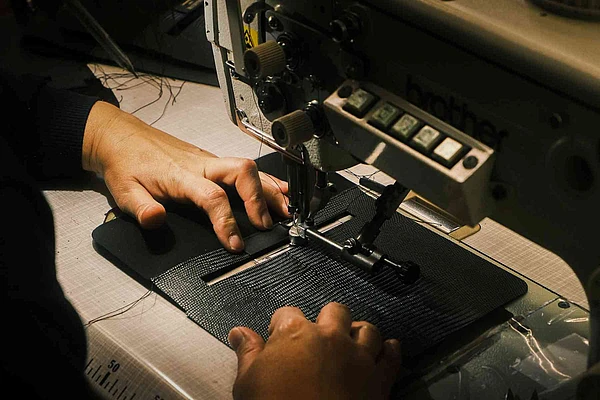
The Product development unit is on a continuous rhythm (patternmaking, canvas, prototype, adjustments) between product development and final tuning after the fashion show. The designs mechanics work alone or in pairs, one preparing the material, the other assembling it. Material preparation is another key stage. It includes managing material thickness by refining or reinforcing it through thermobonding, as well as working on marble, a hard surface essential when mechanics use hammer and tools to soften or refine fold areas.
 Photo credits : ©MPL">
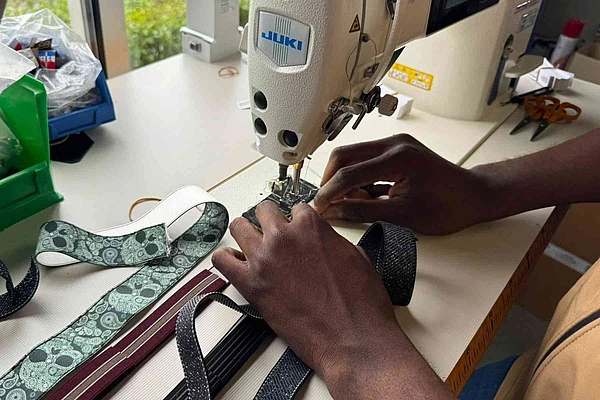
These steps are facilitated by special machines that reflect the specificity of leather : a dozen triple-drive machines adapted to thick materials, trimming machines to refine edges and avoid excess thickness, equipment dedicated to buttonholes and eyelets. Mechanical finishing (embroidered buttonholes, eyelets, trimming, "front" cuts giving a finish close to a hand finish) completes the manual work. Ironing itself requires expertise: without steam, with controlled heat to smooth by "caressing" the piece, without glossing or burning the material.
Once the pieces have been returned from garment making by contract manufacturer partners,"working almost exclusively for us", they are checked, mechanical and hand finishing added (linings, braided trims, buttons) and let us do the quality validation. The manager concludes that "the development-contract manufacturer-quality trio is very important"!
Serving the Homes: strategic technical partners

MPL acts as a veritable industrial orchestra conductor. A dedicated team coordinates all flows, "we take care of planning, organizing production and coordinating teams so that everything is ready on time". This operation is based on a simple principle: "we are transparent with our customers about our internal organization", expresses Constance Lavallard.
Each Home has its own leather identity, both in material and construction, "some work with very fine leathers and classic shapes, others are closer to leatherworking savoir-faire". This diversity feeds the workshop's expertise, which is built up through contact with a variety of styles,"we feed off the learnings linked to the diversity of our customers", explains the manager proudly. La Manufacture provides consulting services to the Home sector. The types of leather we work on range from lamb to calf, sometimes including exotic leathers, even if their use is declining. Issues of traceability and regulatory compliance are also increasingly important.
 Photo credits : ©MPL">
At a time when high-quality skins are becoming increasingly scarce and luxury demands continue to rise, MPL illustrates the ability of a French atelier to combine heritage and adaptation. "I'm only the third manager. What I want to preserve is this continuity between the managers and the workshop, this notion of attachment and craftsmanship", expresses Constance Lavallard. A vision that sums up the identity of a workshop where tradition, expertise and passion meet to bring to life, piece after piece, the excellence of French leatherwork.
To find out more about Manufacture de Peausserie de Luxe, discover its company sheet.