Marcy, a legacy of penmanship

At its head, Marie-Laure Coltee embodies a family tradition where gesture is combined with reflection, experimentation and constant creativity. Here, nothing is standardized, as each feather imposes its own rhythm through texture and color, and each order becomes a field of invention at the service of designers, Luxury houses and the performing arts.
The story of a family craft

The place is inseparable from the history of the Coltee family. In 1850, evening gowns and bridal wear were made here in spaces already designed to accommodate pieces of varying volumes, a modularity still invaluable today for notably "large Music-Hall pieces", notes the manager.
In 1966, his father founded the workshop. Trained as a cabinetmaker, he began by making professions for feather workers, notably for his own parents who produced the famous swanskin puffs, before becoming a feather craftsman himself. The company underwent a period of rapid expansion, growing from a network of home-based workers in several regions to nearly 70 on-site employees. Then international competition upset the economic balance with the arrival of imported products at very low prices, forcing the workshop to reinvent itself to meet the demands of the greatest luxury Houses, a major part of its clientele.
Today, the workshop operates with a tightly-knit team of around ten people, all highly versatile. "They have trained very well through in-house transmission, and our savoir-faire evolves according to demand and therefore fashion". A family structure remains: father, brother, husband, daughter work together, in an informal but continuous transmission, "I didn't do any training in the pen but I've been here since I was two years old", confides the manager.
A matter under constraints: select, protect, archive

In featherwork, the work begins long before assembly, it starts with understanding an organic, fragile and regulated material. "In the past, we'd go and pick from the living without thinking about the consequences", admits Marie-Laure Coltee. Today, only feathers from authorized species and food consumption are used (rooster, turkey, hen, goose, ostrich, pheasant, partridge...), which means having to deal with variable availability and prices, as well as traceability requirements. Sanitary constraints are onerous, and logistics particularly risky: "if a customs document is missing, the parcel is destroyed. There's no insurance", expresses the manager.
The feathers arrive cleaned and pre-sorted, but a second sorting is systematically carried out in the workshop. Length, suppleness, density, hue, regularity: each criterion conditions future use. "There are wing feathers, tail feathers, body feathers... different sizes". This selection is decisive, as you don't choose the same feather for a fringe, a boa, embroidery, an ornament or an accessory.
"The feather keeps very well if it's well protected, as we're on a cellulose and keratin composition", clarifies the manager. Feathers don't like light or moths! Hence our extensive storage organization, with a 1,500 m² warehouse and on-site reserves on several levels, to secure the material and preserve an exceptional archive.
Some of the feathers date back to 1890 and are only intended for museums and the performing arts, since "our archives are never used for commercial purposes," recalls Marie-Laure Coltee. They are used for reconstruction and design work for major productions: operas, theater, cinema, Disney, The Lion King, The Three Musketeers, or more recently Emily in Paris. A way of bringing heritage to life, while preserving the rarity of old materials.
Transforming feathers, gestures, Dyeing processes and bespoke design

Once the material has been selected, the real heart of the profession begins: transformation. Dyeing processes play a central role here. Made entirely by hand, using dyes designed for natural and delicate materials, there are no set recipes. Hydrometry, feather structure, color absorption - every parameter influences the result. "You can never reproduce a hue exactly the same way", explains Marie-Laure Coltee.
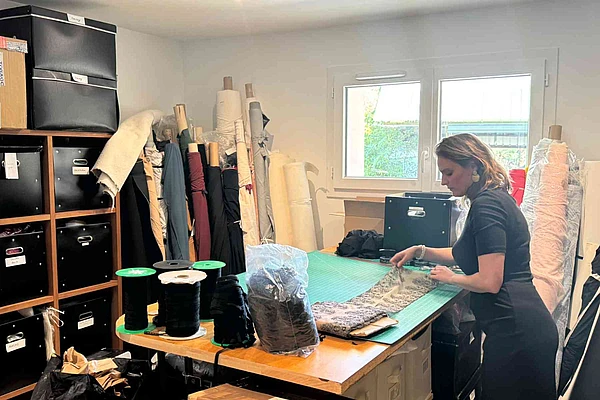
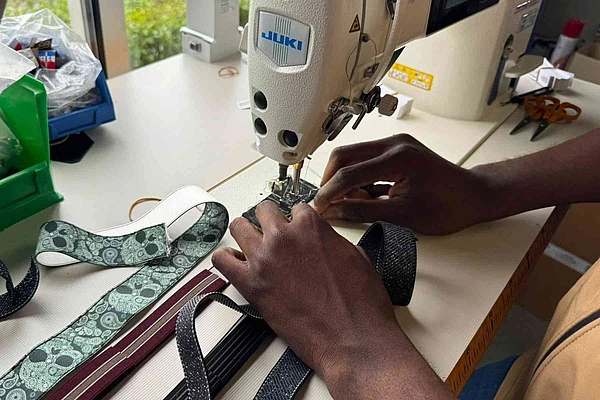
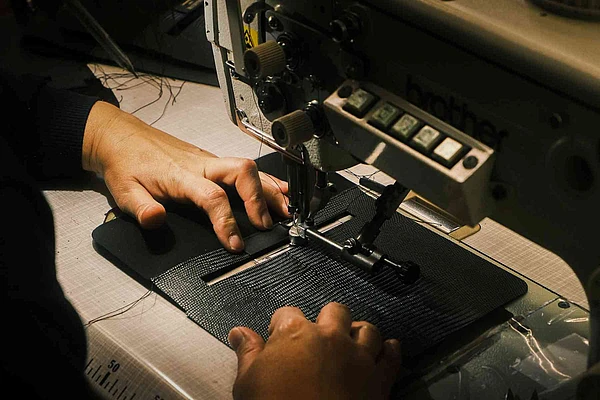
Some feathers require special treatment, while others cannot withstand heat. In these cases, drying must be adapted, without direct heat input, before the feathers are spread out and then beaten to regain their volume. Dyeing processes are not "grand teint", and some dark or bright colors can bleed. We therefore recommend dry-cleaning for certain products to stabilize the color, a constraint we accept in order to preserve the material. The rest of the work is almost exclusively manual. Boas, bangs, tassels, embroidery or accessories all require a real hand."The only machines we have are sewing machines, the rest is the feather worker's hand", declares the manager. For a classic boa, it takes around four days of work, between sorting, Dyeing processes, drying, preparation and turning. This last stage, also known as "frimatage", consists of turning the material on itself, either by hand or using a device developed in-house, to give it volume and movement before being placed on the model.
The workshop also innovates out of necessity. Dyeing processes are reused to create limited batches, sold online to avoid waste and create unique pieces. Online orders are growing, particularly for feather dusters, and the workshop is particularly keen on creating exclusive pieces, sometimes produced in one or two copies only.
Alongside this, Marcy Plumassier is developing her own collections of accessories and jewelry, in warm, gradient colors, which will be presented at the Home & Objet show from January 15 to 19. For Marie-Laure Coltee, the challenge is clear: "the feather is an object of desire, but we don't want it to remain confidential". Democratizing without trivializing, offering accessible pieces without renouncing high standards: a vision true to the atelier's DNA, where heritage, creativity and respect for the material move forward together.
To find out more, discover the company profile of Marcy Feather worker.