The Palais Galliera, protector of the past and future of French fashion

France's most remarkable fashion museum is committed to showcasing not only the designs themselves, but also the professions and Savoir-faire that have always underpinned them. This is achieved through exhibitions and partnerships that demonstrate the vitality of fashion today, over and above its historical heritage.
More than ever, a visit to the Palais Galliera is a must for those involved in and interested in French fashion. Originally conceived by the Duchesse de Galliera at the end of the 19th century to house her art collection, this elegant neo-renaissance building in the heart of the 16th arrondissement changed vocation after its bequest to the city of Paris.
The trigger? Another gift to the capital, in 1920, that of the 2,000-piece collection of the Société d'Histoire du Costume founded by painter Maurice Leloir."The city saw the value of preserving the history of those involved in fashion design. It has enriched this collection through acquisitions and major donations, including 12,000 works in the last ten years, to reach almost 200,000 pieces today, preserved, maintained, restored and shown to the public. We are thus responsible for an inalienable, very rich collection, the most important in Paris and one of the most important in the world", explains Emilie Hammen, director of the Palais Galliera.
From the 18th century to the present day

In 1977, the Palais Galliera officially became the Musée de la Mode de la Ville de Paris, with a collection of historic garments, Haute Couture and contemporary designs ranging from the 18th century to the present day.
Between 2018 and 2020, the Museum will undergo another major evolution: works will double its exhibition space to 1400 m2. "Whereas we were forced to close, sometimes for up to nine weeks between two exhibitions, we can now open permanently with the possibility of organizing two exhibitions at the same time", says Grégoire Ruhland, the Museum's General Secretary.
Between 300,000 and 400,000 visitors have flocked here annually since it reopened. They come and return to a museum that only displays 8% of its fragile 200,000 pieces at any one time, via ephemeral exhibitions. The remaining pieces undergo preventive restoration; a costume exhibited for four months has to rest in storage for four years protected from light!
"Our conservation managers, along with our restorers, take great care to preserve these pieces so that they can live as long as possible", stresses Grégoire Ruhland. The three restorers at the Palais Galliera thus comply with international textile restoration standards, identical to those for objets d'art: legibility, visibility, compatibility and reversibility of interventions. "If additional help is needed, as this is not 're-creation' work, our restorations cannot be entrusted to craftsmen but to external restorers."They follow a set of specifications, with their work monitored by the museum's restorers, in liaison with the curator.
A predominantly French fashion
 Emilie Hammen, director of the Palais Galliera, Grégoire Ruhland, general secretary of the Palais Galliera. Palais Galliera / Paris Musées">
These precautions make it possible to preserve these precious testimonies of an essentially French fashion and garment making. While he finds it complicated to determine the percentage of "made in France" within the museum, Grégoire Ruhland admits that it largely dominates the "historical pieces insofar as globalization is a recent phenomenon". For ready-to-wear, "the style is 100% French up until the 60s, but more systematically from the 70s onwards, a time when tracing provenance is not always possible on manufacturers' labels". For all that, the Museum is keen "to be factual about the history of fashion, its complexity", by focusing its gaze on "career paths, personalities and professions long less valued, even invisibilized. We're invited to tell the story of fashion not just through the prism of the designer labels. This is what we're trying to do in particular with the current exhibition on savoir-faire, by going out to meet its professions."
Lasting ten months, from last December 13 to next October 18, this opus christened "Tisser, broder, sublimer" is the first in a trilogy devoted to savoir-faire (the next two are to focus on mise en volume and materials).
It's one of a series of long-form exhibitions now organized by the Museum on the garden level, focusing primarily on the museum's own exhibits - currently 350 of them (textiles, garments, documents, photographs).
At the same time, other, more ephemeral exhibitions are also opening up to other resources. Currently "18th Century Fashion. A fantasized heritage", open from March 14 to July 12, exhibits an emotionally powerful masterpiece: Marie Antoinette's corset!"
Lumière sur les artisans
 École Duperré, young woman against the light embroidering on tulle
© Cinémathèque Robert Lynen">
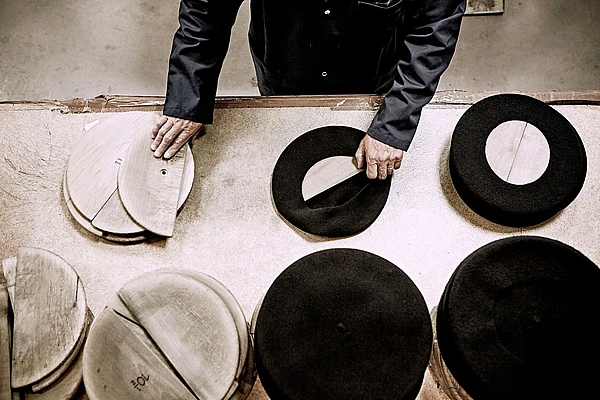
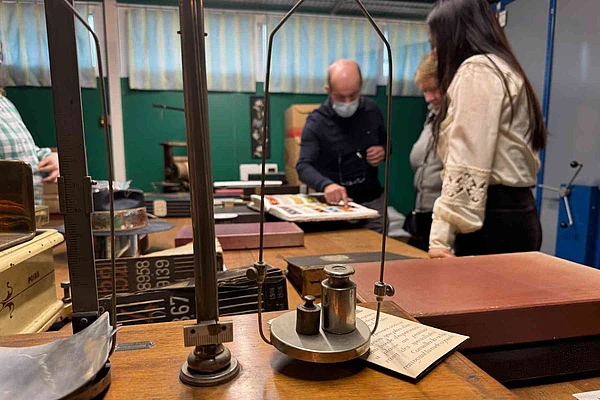
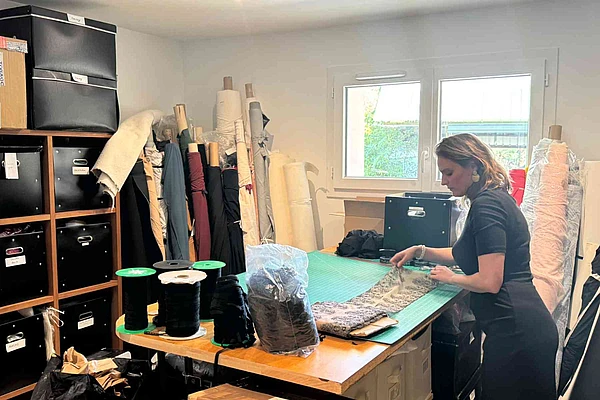
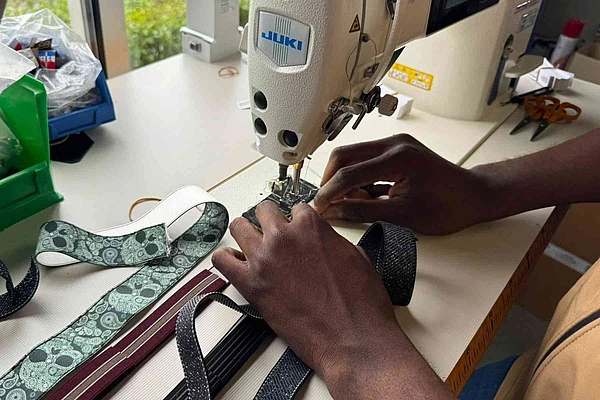
The Savoir-faire exhibition allows, to give a voice to artisans who generally take a back seat to the big names in fashion, yet who are essential in terms of innovation and design", emphasizes Grégoire Ruhland. In addition to a partnership with Chanel's Manufacture 19M, whose workshops are exhibited in the Galerie des métiers d'art, this showcasing is expressed in a variety of ways, with cultural programming and mediation work devised around the exhibition.
During the upcoming Journées Européennes des Métiers d'Art, the Palais Galliera is thus organizing "Rendez-vous d'Exception", from April 7 to 11, including a themed tour of the exhibition and a meeting with an artisan d'art. Embroiderers Laetitia Baqué and Victor Molinié, feather worker Julien Vermeulen, milliner-feather worker Blandine Mercier, textile designers Aurélia Leblanc and Ella Guarrigue, and fine art embroiderer Capucine Herveau, are announced. Grégoire Ruhland emphasizes the interest "in showing how these threads of know-how continue to live on".
Fecund interactions

Another event has been imagined to echo the exhibition by the Palais Galliera with MoMADe, the Campus d'excellence Mode, Métiers d'Art & Design, the network made up of Paris and Ile-de-France fashion schools and the École du Louvre. Students offer visitors mediation and demonstrations of exceptional savoir-faire (embroidery, feathers, artificial flowers, weaving...). Following on from those from Lycées Octave Feuillet and La Source, on January 30 and March 27, students from École Duperré Paris and ENSCI-Textile will be taking part on May 29 and June 26. Emilie Hammen aims to strengthen these "highly fruitful interactions"
Far from being stuck in the past, the Palais Galliera also plays host each year to pieces by the fashion winners of the Grands Prix de la Design de la Ville de Paris. "This support for emerging talent is important because these young graduates and prizewinners are the designers of tomorrow. It is on them that the Houses and workshops will rely to continue creating the pieces that will enter our Museum tomorrow, concludes the director.
As Fast Fashion spreads its universe tentacularly, the Palais Galliera fulfills a mission of public health: reminding the young and the not-so-young of the priceless heritage of fashion and its French manufacture in a globalized world, with its richness, complexity, but also the vitality of its professions. Hurry to the Palais Galliera!