Traceability: a working group tests the best solutions for the clothing industry.

At the beginning of 2023, a pilot traceability program in the apparel sector came to an end. Feedback and key lessons learned.
What traceability solution should be adopted to meet the obligations of the AGEC law? Let's remember: the timetable for application of the text, progressively obliging fashion players to deliver certain information to the consumer, started at the beginning of 2023.
To make companies aware of this and help remove blockages, the CSF (Comité Stratégique de Filière Mode & Luxe) has given impetus to four sector-based traceability pilots in 2021 (Footwear, Clothing, Linen and Textiles), experimenting with solutions that meet their needs.
In early 2023, the one dedicated to Apparel was finalized. Produced with the support of DEFI, the French fashion industry's financing and development platform, and ADEME (the French environment and energy management agency), it was piloted by Cose361 and supported by DEFI in collaboration with industry federations (Alliance du Commerce, Fédération de la Haute Couture et de la Mode, Promincor Lingerie Française and Union Française des Industries Mode & Habillement).
"A benchmarking exercise first enabled us to rate and retain 4 traceability solutions", explains Elise Desrues, deputy general manager of DEFI. They were then auditioned by 13 volunteer companies with diverse profiles (ready-to-wear, lingerie, designers, manufacturers, retailers, etc.)" However, they were judged to be "too expensive" and "not mature or fashion-specialized enough" . "The market had already evolved considerably and companies had more precise expectations".
Four new solutions were then auditioned, of which two - Fairly Made and Retraced- were selected.
Experimentation
From June to September 2022, companies tested them for five products, involving their suppliers. The latter were asked to enter the data required to meet the various obligations of the AGEC law (geographical origin, presence of recycled material, presence of plastic microfibers, mention of the country where weaving/knitting, finishing and garment making mainly take place).
The results obtained are uneven.
"For geographical origin, the aim was to trace back to the spinning mill. Just over half the orders were traced to this stage. 5% were traced to the fiber " says Elise Desrues (DEFI). With a counter-intuitive lesson: the geographical origin relative to fiber and spinning is easier to identify for garments imported from afar than for those manufactured nearby (Euromed zone).
With regard to the obligation to indicate the main country for the weaving-knitting, Dyeing processes-Printing and garment making stages, a rate of 75% was achieved.
Better still, 95% were able to indicate the presence (or not) of synthetic materials likely to release plastic microfibers. And 100% were able to collect information on the use of recycled materials.
However, only 14% were able to retrieve information on possible hazardous substances.
More generally, the pilot enabled us to realize "that there was no perfect solution!" stresses Elise Desrues (DEFI)
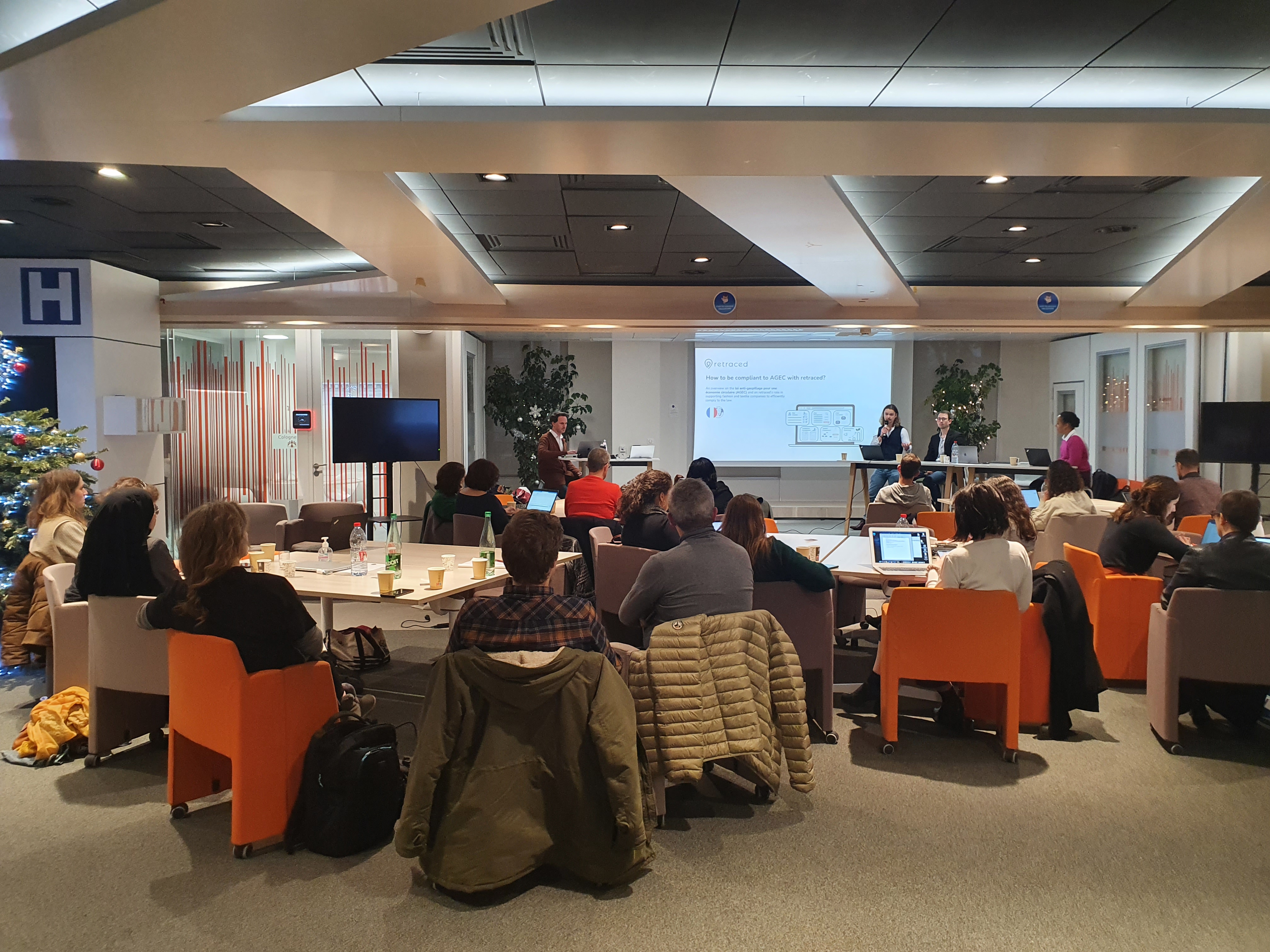
Blocks Detected
Several brakes are also identified.
"Tracking 100% of information was impossible, in particular due to blockages by suppliers, who were over-solicited and didn't have the time to respond to requests for information that were too heterogeneous. Their task would be made easier if we standardized data and definitions, in an interoperable format" observes Elise Desrues (DEFI).
Another sticking point: confidentiality, which no solution can manage. For example, when it comes to geographical origin, some suppliers would prefer not to give the names of their subcontractors.
Last but not least: company organization. "We advise them to get to grips with this quickly once they've defined their traceability perimeter. They should favor suppliers with labels, contact them as early as possible and establish a partnership relationship, explain the regulatory context to foreign suppliers, check their level of sensitivity to confidentiality, some of whom have signed non-disclosure agreements (NDA)".
In a "totally free" and "to anticipate the future" way, the pilot's rapporteurs "also suggested that companies collect more information likely to feature in the environmental display, possibly in force as early as 2024 and so the official reference system has not been finalized." Additional information (data on thread finishing and manufacturing techniques, data on water and energy consumption, etc.) was thus recovered for 75% of products.
To choose the right traceability solution, Elise Desrues (DEFI) advises: "Discard those that can do everything, check their experience in the fashion industry (with its complex chains), see if it is capable of going all the way to the fiber and taking into account all types of products", and finally "choose a solution flexible enough to integrate new data, regulatory developments and standards when they exist".

Elise Desrue, DEFI - Adeline Dargent, FFPAPF
For her part, Adeline Dargent, the CSR manager of the French Federation of Women's Ready-to-Wear (FFPAPF), a stakeholder in this traceability pilot project, noted above all "the lack of maturity of both solutions and companies", The latter have not necessarily "measured the importance of freeing up men's time on these subjects" and "structure data collection" to "be able to feed back more accurate information, particularly upstream, right down to the fiber!"." But in a climate of urgency, linked to the AGEC law, she also notes that "this maturity is evolving very quickly".... What a good time to be there?