Getex, innovation for bold diversification

Founded in 1978 in Challans, Getex has become a benchmark in the manufacture of duck down garments. Under the management of Sophie Pineau since 2011, the company has diversified while preserving its unique savoir-faire in garment making for the luxury and technical markets.
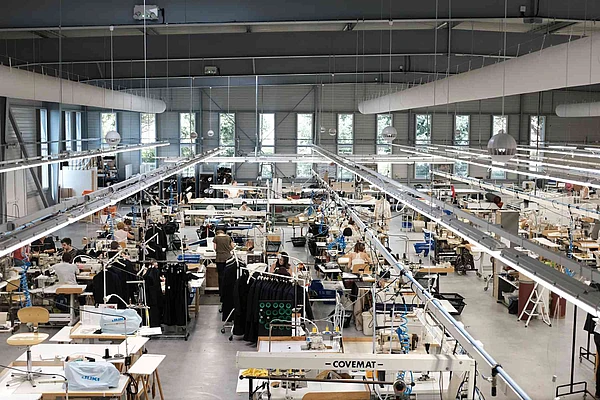
Initially renowned for its expertise in the manufacture of Puffers, today the Getex workshop is recognized for its achievements in demanding sectors such as luxury, military and automotive. With 60 employees in its Vendée workshop, the company devotes 60% of its business to the luxury sector, remaining true to its heritage of savoir-faire and excellence.
Technical Savoir-faire and innovation
 Sophie Pineau, Director of Getex">
Founded in 1978 by the Dugast couple, Getex was taken over in 1992 by Joseph Moreau, father of Sophie Pineau, who led the workshop's activity into a then little-exploited field: "en 1995, there was a major shift as my father directed the company's savoir-faire towards duck down and waterproof garments. So we're specialists in Puffers, even if, with global warming, there's less demand for them. Now, we specialize more in outerwear sleeved garments of all kinds: parkas, windbreakers, bombers, blazers .... ", explains Sophie Pineau.
Getex's technical expertise is at the heart of its reputation. The workshop excels in complex garment making: "nwe apply waterproofing strips to garments, enabling them to be waterproof and breathable", explains Sophie Pineau, underlining the technical expertise required in this field. This expertise is particularly in demand in demanding sectors such as the military, where Getex can notably design CBRN suits, jumpsuits and transport bags.
Technological innovation is thus at the heart of the company's strategy: "we are equipped with LECTRA solutions: Modaris, Diamino latest version (8) and MOZAIC but also CLO 3D for virtual prototyping, notably for SO&J (the workshop's own brand). We're working hard on 3D, with the aim of selling more 3D prototypes, particularly in the metaverse", explains the manager. "We've invested in software that will enable our maintenance manager to draw parts in 3D that he'll put on the machines, guides for example. Once the part has been digitized, we have it machined by a specialized company, or we have it 3D printed, or we buy the materials and our manager does it himself", she adds.
Diversification, a heritage in motion

Taking over the reins of the company, Sophie Pineau has strengthened specialization while diversifying into new sectors, notably automotive. "In 2012, we began manufacturing industrial canvas, in other words, the roof interiors of convertible cars. We have notably produced the DS3 convertible, the Opel Adam and recently the Land Rover Defender, and we were recently appointed to manufacture the roof for the electric 4L", she recounts. This ability to respond to a variety of markets is a testament to the company's flexibility and innovation.
Continuous innovation that is genuinely sought after by the CEO, who explains that "in 2024, we experienced a great moment for the company, I did a capital increase and brought in an Investment Fund to help me continue to develop the business. I need to exchange ideas with people outside the company to go further in my strategic thinking. We're continuing to diversify our activities". So far, this diversification has enabled the company to expand its customer wallet, but it has also led to a significant development of its technical skills. Sophie Pineau points out that "it's not the same way of working at all. Working for this (automotive) sector has even made us evolve over the clothing sector in terms of regularity and time, but also in our fight against musculoskeletal risks thanks to numerous automations", explains Sophie Pineau.
Human values and a responsible approach
 Photo credit : ©Getex SO&J">
In addition to its technical performance, Getex therefore places a strong emphasis on the well-being of its employees in a collaborative working environment. In 2014, Getex launched its own brand, SO&J, to add value to its dead stock fabrics while offering an ethical and sustainable collection. "On only uses our stocks and supplies, we don't buy anything, it goes in the positive direction of CSR. We create the designs as a team, we want to dress all morphologies and sizes, we make women and men", explains Sophie Pineau. This project, which is part of a socially responsible approach, reflects the company's commitment to sustainable, inclusive fashion, and bears witness to genuine collective innovation.
In this same dynamic, Getex has integrated Lean Management to fluidify communication between the different levels of the company and practices promoting quality of life at work, such as meditation, warm-ups at the workstation, as well as participation in sporting events like "La Joséphine" or the inter-company triathlon. "The company's values are team spirit, mutual aid, openness and innovation", sums up the manager.
The company has invested in the construction of an eco-responsible building, reducing its energy consumption by 60% for an additional 400m2. Its participation in the "toile vertueuse" project initiated by CRESS Pays de la Loire and supported by MGO, illustrates this approach : "We sort and participated in the toile vertueuse project, the idea is to re-employ fabrics, end of rolls and offcuts of cuts", explains Sophie Pineau. These various initiatives and efforts have earned the company "Les Ateliers Engagés" level II and ISO 9001 certifications, attesting to its commitment to quality and sustainability.
Getex thus embodies the excellence of French savoir-faire: "we have a growing demand from brands wishing to produce in France, and even if not all have the means yet, those who choose to do so are making a strong decision", asserts Sophie Pineau. Thanks to long-standing partners, Getex actively contributes to the influence of historic savoir-faire, while highlighting the quality and innovation that characterize French production, notably through diversification to meet market needs.
To find out more, discover the Fiche de Getex.