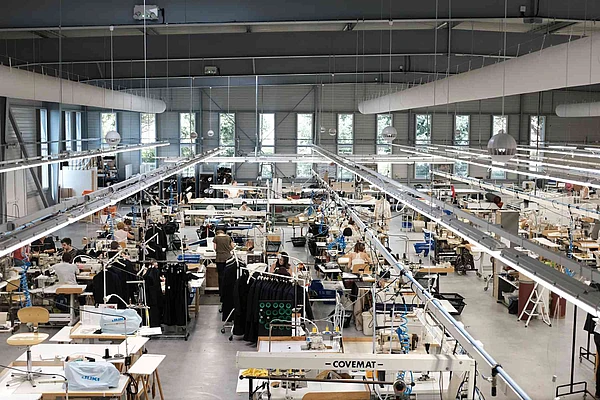
Atelier Caraco where sewing becomes a living art

In a charming Parisian atelier where historic corsets, stage silhouettes and Haute Couture prototypes meet, Atelier Caraco has been cultivating a rare savoir-faire for almost forty years, on the frontier between runway shows and the performing arts. Theater, opera, ballet, cinema, batches, museums or store windows: here, the garment is a living construction, designed for a body, a role, a movement.
Created and directed by Claudine Lachaud and supported by a team of a dozen highly skilled talents, the atelier has established itself as an international benchmark for corsetry and costume. Today, Caraco is more than ever asserting its identity and heritage, notably through the launch of the Garde-robe brand, managed by Claudine Lachaud and Fleur Demery, conceived as a natural extension and transmission of forty years of design.
From show to fashion, a trajectory shaped by made-to-measure

The history of Atelier Caraco was first written on stage. In the late 1980s, Claudine Lachaud was working at "A la bonne Renommée" when she collaborated with costume designer Catherine Leterrier on the film La Révolution (1989). Very quickly, she developed what she then called a "flying workshop", before settling permanently in a place that would become a key hub for stage costume.
Without having premeditated it, Claudine built an exceptional workshop, specializing in corsetry and costume in an approach close to Haute Couture. "We accompany an idea from start to finish, from design to the stage", she explains. Designing the designs, Draping in canvas, choosing the fabrics, multiple patternmaking and fittings, final deliveries: everything is conceived on site, in constant dialogue with the designers.

In the 1990s, the atelier naturally opened up to fashion. The era restored the corset to a central place in the female silhouette, and Homes such as Chantal Thomass, Christian Lacroix, John Galliano and Jean Paul Gaultier sought out the atelier. "After a start very much rooted in show business, fashion emerged as another way of exercising our savoir-faire", stresses the founder.
But the two worlds remain profoundly different. Where fashion adheres to size scales and repetition logics, the show imposes absolute bespoke. "A costume is made for a specific person: you have to be able to sing, dance, breathe, wash the garment after each performance, and sometimes adapt to a new cast", Fleur details. Right from the design stage, garment construction must allow for alterations; stretchable materials, anticipated hems, etc... Conversely, in fashion, patterns are archived, standardized, reproducible.
A total workshop: techniques, collaborations and living memory

Over the decades, Atelier Caraco has developed a particularly wide range of skills. In addition to cutting and assembly, the atelier masters patina, Dyeing processes and certain embroideries, and calls on a network of specialized craftsmen, depending on the project. Milliners, embroiderers, bootmakers, feather workers: the coherence of the final silhouette is built collectively. "When you make a complete costume, collaboration is inevitable and essential", asserts Claudine.
The organization of the workshop reflects this diversity. Around ten people work here permanently, but the team can rise to fifty depending on the project. "We go through tsunamis and troughs", confides Fleur. All projects are visible to all, even if not everyone intervenes on every piece.
Over nearly forty years, more than 3,000 patternmakings have been developed, ranging from second skins to luminous costumes for science-fiction cinema. From futuristic costumes for Valérian by Luc Besson to prehistoric beast skins for RRrrr!!! by Alain Chabat, via historical productions: recreation of the 1875 opera Carmen by Christian Lacroix in 2023, iconic designs from Christian Dior's 1947 catwalk show for the The New Look series. The studio has acquired a unique capacity for visualization and reconstruction. "Sometimes all we have is a sketch or photo without measurements. We have to imagine, understand and technically translate the part", explains Claudine.

Museum reproduction is another major part of the business. The heritage department of the Maisons de Couture regularly entrusts the studio with the recreation of pieces too fragile to be exhibited. In 2013, Caraco produced all the vintage lingerie for the exhibition La mécanique des dessous at MAD. More recently, the atelier reproduced Marie-Antoinette's dresses from Vigée Le Brun's portraits for an exhibition in Japan.
Manufacturing remains resolutely French, even when certain operations are outsourced. Fabric offcuts are conserved, stored and reused. "With Christian Lacroix, with whom we've been working for thirty-five years, there's always a patina on the fabrics for the Opera, like an extra soul, the fabric is never used as is", clarifies the manager. In fact, in addition to manufacturing, Caraco also works on finishing garments and materials within the workshop, which has a patina and Dyeing processes workshop.
Transmission, durability and the affirmation of a signature: Garde-robe

At the heart of the atelier, transmission is an essential driving force. The team is young, around thirty on average, and made up of workshop managers, work-study students, interns and temporary workers mobilized according to the project. The hand-stamped patterns are classified by category, period and year. They are deliberately not digitized. "The patterns evolve with each new request and rework. Art of living constantly improves them", she insists.
"The workshop is a factor in maintaining savoir-faire. The pleasure of sewing together is something profoundly artisanal and collective. Sewing is a form of meditation", she confides. Being at the service of designers, whom she describes as "visionaries", is at the heart of her approach. "Couture is an infinite path: you're never done learning it", declares the founder.

It is precisely this wealth that Caraco wanted to make visible and perpetuate by launching Garde-robe. "Garde-robe is the child of Caraco", explains Fleur Demery. Conceived as a workshop-boutique, the project is based on two axes: professionals, with a pattern library spanning the ages, and the public, to whom pieces from these designs are offered, adapted, transformed and customizable, and the manufacture of made-to-measure pieces for private customers.
"We want to bridge the gap between costume and fashion, take our time, get away from hectic schedules and offer more sustainable, more personal fashion that you keep for the rest of your life", asserts Claudine Lachaud. Claiming a signature, stepping out of the shadows, appropriating forty years of work: Garde-robe marks a decisive step in the atelier's history.
In a world often disconnected from the reality of the gesture, Atelier Caraco reminds us that clothing is first and foremost a human, technical and sensitive construction. "We bring together techniques from every era. Each period has its rules, its flaws, its inventions. Industry has brought symmetry, but the body is not. It is in this imperfection that the garment becomes alive and will remain so", concludes Claudine Lachaud.
To find out more, visit the Company fact sheet of Atelier Caraco.