Elite's mastery of knits

In the heart of the Roanne region, historically linked to knits, Elite embodies a reality often overlooked: that of workshops capable not only of producing, but above all of designing the material itself. This specificity sets knitting apart in the textile chain, halfway between industry, craftsmanship and technical development.
When Geoffroy Vermeulen took over the company in 2022, he was part of a history whose depth he was gradually discovering. The workshop, founded in 1928 by a migrant from the East, has gone through the industrial cycles of the French textile industry between industrialization and relocation, before entering a new phase today: that of relocation and rebuilding skills.
From thread to fabric: textile construction know-how

In contrast to classic garment making, where you assemble an existing fabric, "what's exciting about our profession as knitters is that we create the fabric", expresses Geoffroy Vermeulen. A reality that implies a fine understanding of the thread, structure and behavior of the knits.
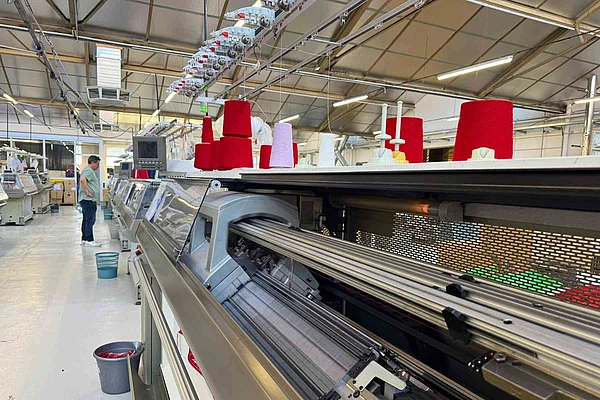
At Elite, this ability translates into great technical freedom: the machines, all Shima-type, allow us to work on different gauges, from 3 to 12, and explore a wide range of renderings. The workshop can mix up to 18 threads on the same fabric, playing on tensions, textures and interactions between materials.
The material, precisely, is a central issue. On average, it accounts for 30% of a product's cost price, which means it has to be rigorously controlled from the moment it is received. Each cone is weighed, checked and analyzed, as there are frequent discrepancies between theoretical and actual weights, due in particular to the relative humidity of the threads. Today, the workshop works mainly with natural fibers such as cotton, merino wool, alpaca and cashmere, with the capacity to transform raw materials as well, right up to felting.
This upstream control conditions everything else in the chain, since it has an impact on knitting behavior, product durability and, of course, final quality. In knits, material and structure are inseparable.
Programming, adjustment, assembly: a complete technical chain

Elite's savoir-faire is based on an organization of professions performed with versatility by the dozen or so skilled people present in the workshop, each intervening at a key level of the process. The sampler programs the machines and develops the prototypes. He translates a stylistic intention into technical instructions, defining gauges, stitches, tensions and sequences.
The setter then intervenes on the machine itself: he adjusts mechanical and electronic parameters, calibrates the thread feed and guarantees program reproducibility. Finally, the operator supervises production, feeds the machines and checks that knitting is running smoothly. "The knitter is both the setter and the operator", explains Geoffroy Vermeulen.
This chain enables largely automated production, with one operator able to control up to 6 to 8 machines, but remains dependent on a high level of expertise. Daily maintenance is a good example: daily lubrication, weekly cleaning of needles, constant monitoring of equipment condition, adjustments and repairs.
The development phase occupies a central place in this organization, indeed "our added value lies in our ability to seek development solutions, sometimes even for six months", explains the manager. Each design is the fruit of successive trials, aimed at finding the right balance between aesthetic rendering, technical feasibility and production cost. Geoffroy Vermeulen points out that "at our company, one of the key jobs is technical fashion design", as it enables us to transform a technical file into a concrete product, integrating all the constraints of knitting.
Knitting and garment making techniques: precision and arbitration

Elite Design masters several knitting techniques, each involving choices in terms of quality, cost and yield. Fully fashion, for example, enables panels to be knitted to exact dimensions, limiting off-cuts to less than 10%. Conversely, straight panel knitting generates up to 30% waste, but remains faster and simpler to produce.
The workshop does not practice full fashion, but makes full use of the possibilities offered by flatbed machines, particularly in jacquard. Two types are used: piqué knit jacquard, with up to nine colors, although in practice the technical balance is around four threads per row, and positive/negative jacquard, playing on both borders to create relief and contrast effects.
The assembly stages then come to structure the final product. Several techniques coexist: overlocking, which is fast and widely used; flat stitching; gluing, particularly for necklines; or linking knitwear, which is more technical and involves recreating a knit between two panels for a more qualitative finish. Mending makes it possible to repair a defect directly on the fabric, a practice that has become relevant again with certain recent technologies.
These technical choices are also economic trade-offs. Simplifying certain operations, for example remeshing only the neckline, a key comfort zone for the customer, helps contain costs while preserving perceived quality.
Linking knits: rebuilding a technical ecosystem

Relocating production involves more than just reinstalling machines. It involves rebuilding a complete ecosystem around skills, suppliers and working methods. "It's not so easy to repatriate production that had been relocated during the previous decades because many skills have disappeared in the region", notes Geoffroy Vermeulen.
Faced with this, Elite is banking on in-house training, tutoring and the direct transmission of savoir-faire. The workshop thus combines experienced profiles, sometimes with over 40 years' experience in the professions, with new recruits trained on site as part of a continuous learning process.
This reconstruction also involves local sourcing, with partners such as Laine Paysanne and Filature du Parc, and diversification of customers. Today, the workshop works with around a hundred active brands, on volumes ranging from 50 to 300 pieces on average, with a gradual increase in French production, which will become the entire business by 2026.
While the cost differential with certain European countries remains real, on the order of 30 to 40%, technical added value and development capacity are differentiating levers. Particularly since, in an uncertain environment, proximity, responsiveness and know-how are once again decisive criteria. In Roanne, Elite illustrates a broader dynamic. That of a sector that is maintaining and reinventing itself, drawing on what makes it special, which is fine technical expertise, at the service of textile design.
To find out more, discover the company profile of Elite.