Atelier Esperen: garment making as a commitment and a positive impact

At the heart of an artisanal cooperative in Rennes, the Esperen workshop gives life to many types of high-end products while weaving new horizons for its members. Founded in 2023, this Breton association with a social and environmental impact combines garment making and support for employment. Led by Marion Levesque until July 2025, the association is much more than a garment making workshop: it's a melting pot of savoir-faire, a gas pedal of opportunities and a committed player in the ecological transition.
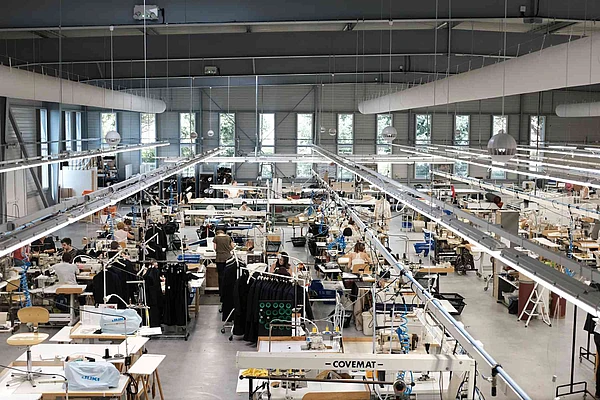
Born out of a desire to meet the recruitment needs of Breton companies and develop the skills of people who are far from employment, often from migratory backgrounds, Esperen is now helping a dozen women return to work through garment making. In this cooperative space with 20 garment making machines, each piece produced tells a story of resilience, agility and quality craftsmanship.
A workshop born of experience and territory

Esperen will set up in Rennes in 2023, following the Espero model from which Marion Levesque originated, after an initial field study phase in 2022. The idea was to go out and meet the people supported by local social structures, in order to identify existing savoir-faire. The manager recalls this period as a decisive moment: she discovered highly qualified profiles from a variety of backgrounds. "Some people have worked in the classic textile industry, others in the craft or high-end sectors. One seamstress even has 30 years' experience in high-end tailoring in Russia", she declares.
If garment making is rapidly establishing itself as a core profession, it's also because Brittany still has a historic textile and leather goods basin that is constantly recruiting. Esperen took its place in the 1,000 m² craft cooperative, creating a textile hub alongside wood and metal professionals. Machines are shared, materials are collectively sourced, and the site also hosts training courses for private individuals.
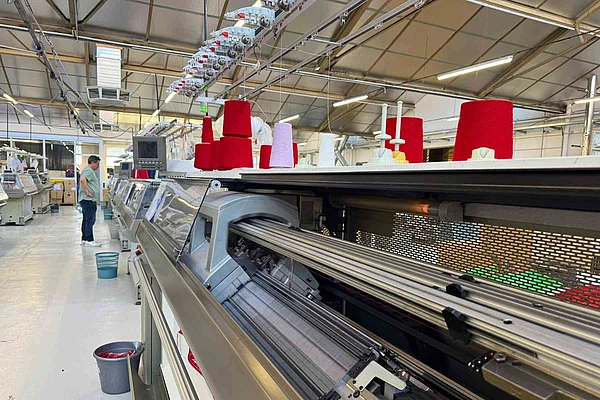
The workshop is structured around a small team: The workshop is structured around a small team: 9 (or 10) people, including 7 seamstresses on integration courses, a workshop manager and a part-time integration officer. "Given our size and identity, we opted for agility", explains Marion Levesque. The company's machinery is focused on cut and sew knits and warp and weft, two skills that enable us to make a wide variety of pieces.
An insertion centered on know-how and people

The heart of the Esperen project is people. The association mainly welcomes refugee or displaced women, most of whom arrived in France less than five years ago. They stay in the workshop for between 12 and 18 months, with a maximum duration of two years. Many are Ukrainian, in their forties, with a strong appetite for manual labor."These are people who have had rich lives, experiences, skills", Marion Levesque reminds us.
The aim is clear: to put these skills back to good use to encourage lasting integration. Some go on to join workshops in the region, while others continue their training in French, technical fashion design or basic skills, as language remains an issue. In addition, mobility between Rennes and Nantes, where the workshops are concentrated, can be a major obstacle to integration.
Despite this, the workshop operates on a continuous production basis, and the seamstresses are multi-skilled, with the workshop manager adapting the distribution of production according to each person's strengths. A 10-day training course, in partnership with GRETA, is scheduled for the autumn to anchor technical know-how and professional vocabulary with the teams.
Agile production, measurable impact

Esperen operates on two production lines: a white labeling-oriented medium batch line, whose customers are mainly industries, institutions and companies, and a premium line for custom manufacturing, reserved for high-end pieces in small batches or one-off pieces concerning more fashion Homes and young designers.
In 2024, 4,000 pieces were produced. And this figure can still rise. The workshop works with a partner for automatic machine cutting, but retains a handcrafted element. Products are varied: sweatshirts, t-shirts, bags, bucket hats, aprons... "technical materials, fine jersey or thick materials" are at the heart of production, with gradual specialization towards segments like workwear or thick-sleeved garments. "We don't make shirts, except in very small batches. We make pants, tailoring - the workshop manager's area of expertise - chinos... Only made-to-order", Marion Levesque explains.
Environmental impact is a priority: more than half our projects are based on upcycling, with all the parts and fabrics used being saved from destruction. Some customers also recuperate offcuts, with a view to reuse. Coming soon: GOTS and OEKO-TEX certification. "Our customers are sensitive to our social impact, and it's really French savoir-faire that's in demand", observes Marion.
On the network side, Esperen benefits from a partnership with the FIM group in the form of patronage. This support enables the workshop to exhibit at events such as the Made in France Première Vision show, to which it is invited. In return, Esperen brings in qualified profiles for recruitment: a win-win dynamic that strengthens the bridges between integration and industry.
Today, Esperen is a structure independent of Espero, but sharing the same founding values: high standards, transmission, support. The arrival and takeover of Vincent Marchix, in July 2025, marks a new phase of structuring. The workshop seeks to strengthen its production methods, improve productivity and develop public commissions. "I come for the values", he asserts. And at Esperen, every stitch links insertion, French quality and sustainable commitment.
Discover the atelier Esperen company sheet.